The Vaccine You Shine Onto a Plant
How controlled UV-C stress can prime crop defence when dose, timing, and safety are right
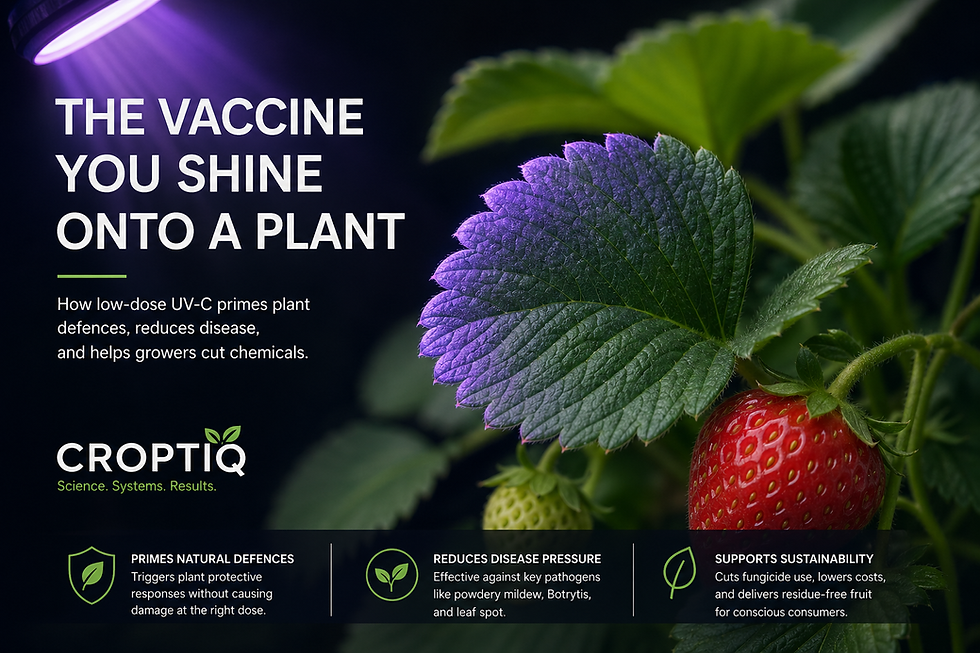
There is a strange idea hiding inside crop science, and once you see it, it is hard to unsee: a small, carefully measured dose of something that would damage a plant at higher levels can instead make it stronger, not in a vague or inspirational sense, but measurably. The plant can become more disease-resistant, more stress-ready, and better prepared to respond when biological pressure arrives.
The “something” is ultraviolet-C light, the same part of the spectrum used to disinfect drinking water, clean surfaces, and reduce microbial pressure. Shine too much of it onto a leaf and you can scorch it, but deliver a carefully measured dose and the plant can respond in a way that is comparable to a vaccine in one useful sense: a controlled stress prepares it for a more serious biological challenge.
This is called hormesis: the biological effect depends on dose, and in protected horticulture it is one of the more interesting frontiers in crop protection.
When a plant detects UV-C, it does not ignore it. Defence-related signalling can switch on, cell walls can become harder to penetrate, and antioxidant pathways can increase. The plant has not yet been attacked by mildew or Botrytis, but it has been warned, in a chemical language it understands, that an attack is plausible, so it spends energy preparing.
The clearest commercial example is strawberry. Powdery mildew is a constant headache for strawberry growers, and chemical programmes are under pressure from resistance management, residue expectations, labour availability, and consumer demand for cleaner fruit. Trials have shown that repeated night-time UV-C treatments can suppress mildew meaningfully, especially when dose and frequency match disease pressure. Under lower pressure, two night-time treatments per week may be sufficient, while under higher pressure three passes may be needed.
That distinction matters because UV-C should not be presented as a universal replacement for every crop protection decision. It is better understood as a tool that can reduce pathogen pressure and, in the right system, reduce dependence on routine fungicide programmes.
The night-time part is one of the most important details in the whole story. Many fungi can repair part of the UV-C damage when they are exposed to white or blue light afterwards, which means daylight can undo part of the treatment effect. A UV-C pass at midday is partly fighting the repair machinery of the pathogen, while a UV-C pass at night gives the dose more time to land before repair becomes possible.
What makes this work is not a clever feature bolted onto the machine, but biology. Repair mechanisms are written into plants and fungi because life has been dealing with ultraviolet radiation for hundreds of millions of years. We are not inventing the trick, we are using one that already exists.
There is a catch: hormesis works on a curve. Low doses can prime, well-targeted doses can suppress pathogens, and high doses can damage crop tissue. The right dose depends on the crop, variety, leaf age, canopy structure, lamp distance, robot speed, humidity, pathogen pressure, and available dark period.
Get it wrong on the high side and you may see leaf bleaching or growth stress; get it wrong on the low side and the grower sees nothing meaningful, which is often the more expensive mistake. The difference between a system that earns its keep and one that disappoints is rarely the hardware alone. It is calibration.
This is also why UV-C should never be sold or treated as a simple lamp-on-wheels solution. It is a biological dose delivered by a machine, and plant safety and worker safety depend on proper shielding, interlocks, warning routines, night-time operation, trained operators, and regular dose verification. UV-C can be valuable, but it is not casual technology.
For anyone simply curious about plants, the deeper takeaway is this: a primed plant responds differently to the next stressor because something has changed in how it is reading the world. There is no nervous system and no brain, only chemistry, signalling, and a kind of preparedness written into the regulation of genes, and we can switch it on deliberately with a wavelength of light.
The real promise of UV-C is not that it kills everything, because it does not. It will not solve soilborne disease, poor hygiene, weak climate strategy, or a badly designed crop protection programme. Its promise is more specific and more useful: when dose, timing, biology, and safety are properly calibrated, UV-C can become part of a cleaner, more intelligent crop protection system.
Croptiq advises growers and technology providers on UV-C deployment, biological fit, dose strategy, safety, and the practical integration of robotics in protected horticulture.


Thank you for sharing this content and I am enjoying the new site, its tools and thought leadership